




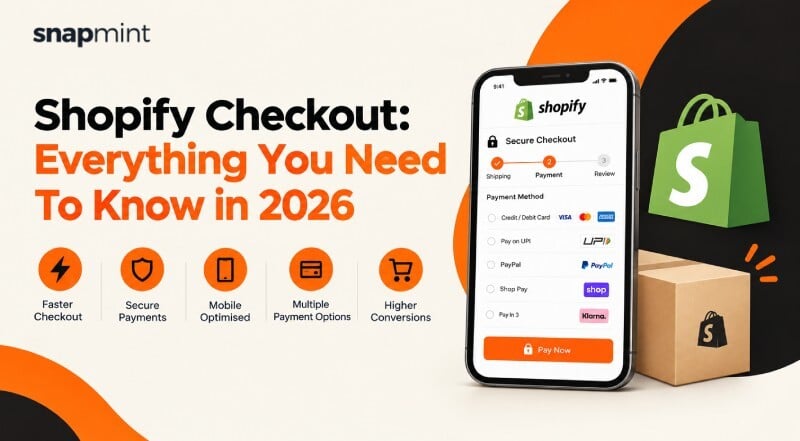
Introduction
For a Shopify store, checkout is where browsing turns into revenue.
A customer can discover a product through search, social media, an advertisement, or a recommendation. They can visit the product page, add an item to their cart, and still leave without buying if the checkout process is slow, confusing, restrictive, or lacks the payment option they prefer.
This makes Shopify Checkout more than a payment page. It is a critical part of the ecommerce conversion journey.
Shopify has built its checkout experience around speed, security, multiple payment methods, mobile usability, and extensibility. Depending on the Shopify plan and setup, merchants can also customise parts of the checkout experience and use accelerated checkout options such as Shop Pay.
What Is Shopify Checkout?
Shopify Checkout is the part of a Shopify store where customers enter their shipping and payment information, review their order, and complete the purchase.
It comes after the cart and before the order confirmation.
A simplified Shopify customer journey looks like this:
Product Page → Cart → Checkout → Payment → Order Confirmation
Shopify then processes the checkout according to the store's configuration, payment setup, shipping rules, taxes, discounts, and other settings.
The exact checkout experience can vary based on the merchant's location, Shopify plan, payment providers, installed apps, store settings, and customer device.
How Does Shopify Checkout Work?
The Shopify checkout process is designed to move customers from their cart to completed payment through a structured sequence. A typical journey looks like this:
Step 1: Customer Adds a Product to Cart
The customer selects a product and adds it to the cart.
The cart may display:
- Product name
- Quantity
- Product price
- Discounts
- Shipping information
- Estimated total
- Available checkout options
Step 2: Customer Proceeds to Checkout
The customer clicks Checkout.
Shopify creates the checkout session and presents the information required to complete the order.
Step 3: Customer Enters Contact Information
Depending on the store configuration, the customer may provide:
- Email address
- Phone number
- Shipping details
Returning customers may have some information pre-filled depending on the checkout and accelerated payment experience being used.
Step 4: Customer Enters Shipping Details
The customer provides their delivery address. Shopify uses this information to determine applicable shipping rates and available delivery options.
Step 5: Customer Selects a Payment Method
The customer chooses from the payment methods enabled by the merchant. Depending on the store and country, this may include:
- Credit cards
- Debit cards
- UPI
- Net banking
- Digital wallets
- Buy Now, Pay Later
- EMI
- Other local payment methods
Step 6: Order Is Reviewed and Paid
The customer reviews their order and completes the payment. If the payment succeeds, Shopify creates the order.
Step 7: Order Confirmation
The customer receives an order confirmation and the merchant can begin fulfilment.
Shopify Checkout vs Shopify Cart
These two terms are often used interchangeably, but they serve different purposes.
|
Feature |
Shopify Cart |
Shopify Checkout |
|
Primary purpose |
Review selected products |
Complete the purchase |
|
Product quantity changes |
Yes |
Limited |
|
Shipping information |
Usually not required |
Required |
|
Payment information |
No |
Yes |
|
Discount application |
Often available |
Available depending on setup |
|
Final purchase |
No |
Yes |
|
Conversion importance |
High |
Very high |
Key Features of Shopify Checkout
Shopify Checkout includes several features designed to simplify the purchase process.
1. Mobile-Friendly Checkout
A large share of ecommerce traffic comes from smartphones. Shopify's checkout experience is designed to work across mobile and desktop devices, allowing customers to complete purchases without needing a desktop computer.
For D2C brands, mobile optimisation is particularly important because customers may discover a product on Instagram, Google, YouTube, or another mobile-first channel and proceed directly to checkout.
2. Multiple Payment Methods
Payment flexibility can play an important role in conversion. Shopify merchants can configure different payment methods depending on their market and payment provider.
For example, a higher-AOV D2C brand may benefit from offering both UPI and EMI, while a low-AOV brand may see most of its demand concentrated around UPI and cards.
3. Shop Pay
Shop Pay is Shopify's accelerated checkout solution. It allows eligible customers to save payment and shipping information so that future purchases can be completed more quickly on participating Shopify stores. This can reduce the amount of information customers need to enter during subsequent purchases.
For merchants, accelerated checkout can be particularly useful for returning customers who already have familiarity with the payment experience. However, Shop Pay availability and functionality can vary by country and store eligibility.
4. Accelerated Checkout Buttons
Shopify stores can use accelerated checkout options to allow customers to bypass some conventional cart steps. Depending on the setup, customers may see options such as:
- Shop Pay
- Apple Pay
- Google Pay
- Other supported accelerated payment methods
These options can be useful for customers who already have their payment and shipping details stored with the relevant provider.
The key advantage is speed.
5. Discount Codes
Shopify checkout can support discount codes configured by the merchant. Discounts can be based on different rules, such as:
- Percentage discounts
- Fixed-amount discounts
- Free shipping
- Product-specific discounts
- Collection-based offers
- Customer eligibility
However, brands should be careful about adding unnecessary friction around discount codes. If customers have to leave checkout to search for a coupon, they may become distracted or abandon the purchase.
6. Shipping and Delivery Options
Checkout uses the customer's shipping information to determine available delivery methods and applicable charges. Depending on the merchant's configuration, customers may see:
- Standard shipping
- Express shipping
- Free shipping
- Local delivery
- Pickup
- Other delivery options
Clear delivery information is important because unexpected shipping charges are a common source of checkout friction. A customer who sees:
Product: ₹1,499
and then discovers:
Shipping: ₹299
at the final stage may reconsider the purchase. Brands should therefore communicate shipping charges as early as reasonably possible.
7. Address Validation
Accurate customer information is important for successful fulfilment. Depending on the Shopify setup and apps being used, merchants can implement address validation and related checkout functionality. For Indian D2C brands, pincode validation can be particularly useful because serviceability and delivery timelines can vary significantly across locations.
Shopify Checkout Customization
Shopify has increasingly moved toward a checkout extensibility model rather than relying on unrestricted modifications to checkout code. This provides merchants with structured ways to extend checkout while maintaining Shopify's core checkout infrastructure.
What Can You Customize in Shopify Checkout?
Depending on your Shopify setup and available features, customization can include areas such as:
Branding
You can customise aspects of the checkout's visual presentation, including:
- Logo
- Brand colours
- Typography
- Button styling
- Background elements
The goal is to maintain consistency between the storefront and checkout.
Checkout Content
Brands can use supported extensions and settings to display relevant information, such as:
- Trust messaging
- Delivery information
- Product information
- Policies
- Additional checkout content
Customer Information
Depending on the available Shopify features and extensions, merchants can modify or extend parts of the information collection process.
For example, a business may need additional information for certain product categories or fulfilment workflows.
What Is Shopify Checkout Extensibility?
Shopify Checkout Extensibility is Shopify's framework for customizing and extending checkout using supported extension points rather than directly modifying the underlying checkout code.
This is important because traditional checkout customizations based on modifying Shopify's checkout code have increasingly been replaced by Shopify's extensibility approach.
Checkout extensibility can provide merchants with a more structured way to add functionality while remaining compatible with Shopify's checkout architecture.
Examples of possible extensions include:
- Custom checkout content
- Additional information
- Promotional messaging
- Apps
- UI extensions
- Post-purchase functionality
The exact capabilities depend on the Shopify plan and the extension type.
Shopify Checkout Extensibility Vs Checkout Code Customization
For most merchants, using Shopify's supported checkout extensibility features is preferable to trying to work around the platform's checkout architecture.
|
Factor |
Checkout Extensibility |
Traditional Code Customization |
|
Shopify's preferred approach |
Yes |
Increasingly limited |
|
Upgrade compatibility |
Better |
Can create maintenance issues |
|
App integration |
Structured |
More complex |
|
Technical maintenance |
Generally easier |
Can be higher |
|
Flexibility |
Controlled |
Historically broader |
|
Future scalability |
Better aligned with Shopify |
Less future-proof |
Shopify Checkout Payment Methods
Payment options should be selected based on your target customers rather than simply the number of options available.
For an Indian D2C store, a practical payment mix may include:
UPI
Useful for:
- Mobile shoppers
- Everyday purchases
- Prepaid orders
- Customers without cards
Credit and Debit Cards
Useful for:
- Existing card users
- Higher-value purchases
- Customers seeking card rewards
- International transactions where supported
EMI
Useful for:
- Higher-AOV products
- Electronics
- Furniture
- Fitness equipment
- Premium lifestyle products
Cardless EMI
Useful for:
- Customers without credit cards
- UPI-first shoppers
- Higher-value purchases
BNPL / Pay Later
Useful for customers looking for short-term payment flexibility, subject to provider eligibility and applicable terms.
COD
Useful for:
- First-time customers
- Trust-sensitive customers
- Customers who prefer paying upon delivery
However, COD can increase RTO exposure, so merchants should monitor COD performance separately.
How to Add Payment Methods to Shopify Checkout
The general process is:
- Open the Shopify admin.
- Go to Settings.
- Open Payments.
- Review the available payment providers.
- Select the payment method or provider you want to activate.
- Complete the provider's configuration and verification requirements.
- Test the payment flow.
- Monitor payment success rates after launch.
The exact options available depend on the store's country, business type, Shopify plan and payment-provider availability.
For Indian merchants, choosing the best payment gateway for Shopify in India should also consider:
- UPI support
- Card acceptance
- EMI availability
- Settlement timelines
- Transaction fees
- Payment success rate
- Refund process
- Support quality
- Integration reliability
How to Optimise Shopify Checkout for Higher Conversions
Having Shopify Checkout does not automatically mean your checkout is optimised. A dedicated checkout optimization approach can help identify friction across the customer journey.
Here are some practical ways to improve it.
1. Keep Checkout Simple
Every additional step creates another opportunity for the customer to abandon. Avoid asking for information that is not necessary to complete or fulfil the order.
2. Optimise for Mobile
Check your checkout experience on:
- iPhone
- Android
- Different screen sizes
- Slow mobile connections
Look for:
- Small buttons
- Difficult form fields
- Poor spacing
- Keyboard issues
- Slow loading
- Difficult payment selection
Mobile checkout should be easy to navigate with one hand.
3. Display Payment Options Clearly
Don't make customers search for payment flexibility.
If your brand offers:
UPI + Cards + EMI + COD
make those options easy to understand.
For higher-AOV products, communicate EMI before checkout as well.
For example:
₹18,000
or ₹6,000/month with eligible 3-month EMI
This can help customers understand affordability before they reach the payment page.
4. Be Transparent About the Total Cost
Unexpected charges can create checkout abandonment.
Show:
- Product price
- Discounts
- Shipping
- Taxes where applicable
- Final payable amount
Customers should not have to calculate the final price themselves.
5. Build Trust
Customers need to feel comfortable entering payment information.
Useful trust signals can include:
- Secure payment messaging
- Clear return policy
- Shipping information
- Customer support details
- Refund policy
- Brand information
Avoid overwhelming the checkout with excessive badges and promotional messages.
Trust should be communicated without clutter.
6. Reduce Form Friction
Long forms can make checkout feel like administrative work.
Use:
- Autofill where supported
- Address suggestions
- Clear field labels
- Logical field order
- Appropriate keyboard types on mobile
- Minimal mandatory fields
The easier it is to enter information, the lower the effort required to complete the purchase.
7. Offer Guest Checkout Where Appropriate
Not every customer wants to create an account before purchasing.
If your business does not require mandatory account creation, allowing customers to complete purchases without creating a traditional account can reduce friction.
You can still encourage account creation after purchase.
8. Don't Force Customers to Search for Coupons
A common ecommerce pattern is:
Customer reaches checkout → sees coupon field → searches Google for coupon → leaves website
This is a conversion risk.
If you use discount codes, consider making relevant offers clear before the customer reaches checkout.
9. Monitor Failed Payments
A customer may complete the checkout form but fail to complete payment.
Track:
- Payment failures
- Declined cards
- UPI failures
- Gateway errors
- Refunds
- Duplicate payments
- Payment-method-specific failure rates
A payment gateway can appear to be available while still generating a significant number of failed transactions.
Your payment data should therefore be reviewed regularly.
Shopify Checkout and Page Speed
Checkout performance matters, but it should be approached differently from traditional storefront page optimisation.
For the storefront, brands should pay attention to:
- LCP
- INP
- CLS
- JavaScript
- Image optimisation
- Third-party scripts
Checkout itself is managed heavily by Shopify's infrastructure, so merchants have less direct control over the underlying checkout environment.
However, brands can still reduce friction by optimising the steps leading into checkout.
For example:
Slow product page → Cart → Checkout
If the customer waits several seconds for the product page to load, they may never reach checkout.
Therefore, checkout optimisation should include the complete journey:
Landing Page → Product Page → Cart → Checkout → Payment
Shopify Checkout and Conversion Rate Optimisation
For a broader store-level approach, Shopify conversion optimization should cover the product page, cart, checkout, and payment journey.
Important metrics include:
Checkout Initiation Rate
How many customers who add products to their cart proceed to checkout?
Checkout Completion Rate
How many customers who start checkout successfully place an order?
Cart Abandonment Rate
How many customers add products to their cart but do not complete the purchase?
Payment Success Rate
How often does a payment attempt successfully result in a completed transaction?
COD vs Prepaid Conversion
Compare conversion behaviour across payment methods.
Payment Method Adoption
Understand which methods customers actually use.
For example:
|
Payment Method |
Orders |
Conversion |
|
UPI |
4,500 |
7.2% |
|
Cards |
1,600 |
6.5% |
|
EMI |
700 |
9.1% |
|
COD |
1,200 |
5.8% |
The purpose of this analysis is not simply to identify the most popular payment method.
A less frequently used method can still be valuable if it converts high-intent customers or supports increased AOV goals.
.
Shopify Checkout Abandonment: Common Reasons
Customers may abandon checkout because of:
Unexpected Costs
Shipping or other charges appear later than expected.
Limited Payment Options
The customer's preferred payment method isn't available.
Mandatory Account Creation
Customers don't want to create an account.
Complicated Forms
Too many fields increase effort.
Payment Failure
The customer attempts to pay but the transaction fails.
Lack of Trust
Customers are uncertain about the brand, payment security, shipping or returns.
Slow Experience
Slow pages or technical errors interrupt the journey.
Price Shock
The customer sees the final price and decides the purchase is too expensive.
Flexible payment options can be particularly useful in the final situation.
For example, instead of only offering:
Pay ₹15,000 today
a brand could offer an eligible customer:
Pay ₹5,000/month for 3 months
subject to the applicable EMI terms.
Shopify Checkout Best Practices for Indian D2C Brands
For Indian Shopify stores, a practical checkout strategy should include:
1. Make UPI Highly Visible
UPI is a critical payment method for Indian ecommerce customers.
2. Keep Cards Available
Don't assume UPI replaces cards completely.
3. Add EMI for Higher-AOV Products
If your average order value is high, test EMI and cardless EMI options.
4. Use COD Strategically
Monitor RTO and contribution margin rather than looking only at order volume.
5. Display Delivery Information Clearly
Show estimated delivery timelines before the customer reaches payment.
6. Validate Addresses
Incorrect addresses can create failed deliveries and RTO. For a broader fulfilment strategy, merchants can also review how to reduce RTO in ecommerce.
7. Communicate Payment Flexibility Early
Don't wait until checkout to mention EMI or pay later in India options.
8. Test the Complete Funnel
Optimise:
Product Page → Cart → Checkout → Payment
rather than treating checkout as an isolated page.
Shopify Checkout vs Custom Checkout
Some growing D2C brands eventually consider moving away from Shopify's standard checkout experience.
Before doing so, evaluate whether you actually need a custom checkout.
A custom solution can offer greater control but also introduces:
- Development costs
- Maintenance requirements
- Security considerations
- Payment integration complexity
- Testing requirements
- Potential performance issues
- More operational responsibility
For many brands, Shopify's native checkout combined with appropriate extensions and payment integrations can provide a strong balance between flexibility and reliability.
The decision should therefore be based on a clear business requirement rather than a desire to make checkout "look different."
Shopify Checkout: Common Mistakes to Avoid
Reviewing common ecommerce mistakes can help merchants identify avoidable sources of checkout friction.
Mistake 1: Offering Too Many Payment Options
More does not always mean better.
Prioritise relevant options.
Mistake 2: Hiding EMI Information
If affordability is a key selling point, communicate it on the product page and cart, not only at payment.
Mistake 3: Ignoring Mobile Checkout
A desktop-friendly checkout is not enough.
Mistake 4: Making Shipping Costs a Surprise
Communicate shipping costs early.
Mistake 5: Ignoring COD Economics
Track RTO and contribution margin associated with COD orders.
Mistake 6: Asking for Unnecessary Information
Every additional field creates friction.
Mistake 7: Focusing Only on Checkout
A high-converting checkout cannot compensate for a poor product page, slow website, unclear pricing, or weak trust signals.
Conclusion
Shopify Checkout is more than the final step in the buying journey. It is where pricing, trust, delivery expectations and payment preferences come together to determine whether purchase intent turns into revenue. For Indian D2C brands, optimising checkout means offering a fast mobile experience, relevant payment methods, transparent costs and minimal friction throughout the journey.
Payment flexibility can be particularly important for higher-value purchases, where paying the full amount upfront may become a barrier. Payment solution platforms such as Snapmint can help Shopify merchants offer flexible payment options, including Pay in 3, giving eligible customers more ways to manage their purchases while helping brands reduce affordability-related friction at checkout.
Ultimately, the goal is not to add every possible payment option or checkout feature. It is to understand your customers, identify where they drop off, and provide the right experience at each stage. By combining Shopify's checkout capabilities with flexible payment solutions like Snapmint, D2C brands can create a smoother checkout experience while working toward stronger conversion and healthier ecommerce growth.
.png?width=1700&height=616&name=Group%201597882553%20(1).png)
Frequently Asked Questions