




-1.webp?width=1400&height=638&name=15-proven-strategies-to-minimize-return-to-origin-for-D2C-brands%20(1)-1.webp)
Key Takeaways:
- On an average, 70% of the carts are abandoned due to poor checkout optimization.
- To uplift checkout conversions for your e-commerce brand, introduce autofill forms, one-click checkout, no hidden costs, and display trust badges
- Making products more affordable through no-cost EMIs can reduce cart abandonment and improve conversion rates.
- Sending personalised reminders over email or WhatsApp can nudge high-intent users to complete their checkout.
Even though e-commerce checkout optimization has the highest return on investment of any online store, the majority of brands lose 70% of their customers at this point. Here’s the reason, and what you can do about it.
Imagine this – you spent 500 rupees on marketing to get a new customer. The customer adds things worth 2000 to the cart and doesn't proceed to checkout. That's 500 rupees down the drain! Now imagine this 70% of the time! Market experts say the average cart abandonment rate for e-commerce firms is more than 70%.
That is a big percentage of your marketing budget that returned nothing because customers did not convert at checkout.
But why would you lose a customer who actually wanted to buy something, after he had put it in his cart? What causes low conversion rates at ecommerce checkout? How to increase ecommerce checkout conversion rate?
In this blog, we will address all of your questions on how to optimize the checkout experience for online shopping. We have tested and proven strategies to improve your e-commerce checkout conversion rate and turn your potential purchases into loyal customers.
What Is Ecommerce Checkout Optimization? (And Why It Matters)
Benefits of checkout conversion optimization is about improving your checkout experience to increase the likelihood that customers will complete their transaction instead of abandoning it.
You may enhance your online brand’s checkout process by introducing improvements to the design, flow, and functionality of the checkout process.
The purpose is to eliminate any possible points of friction, such as delayed loading, too many form fields, hidden costs or a lack of payment options.
A good optimized checkout is fast, safe, works on mobile devices and is clear, leading to more sales, less abandoned carts and more money at the end.
How Checkout Conversion Optimization Directly Impacts Revenue
Checkout conversion optimization immediately drives up your income by getting more customers through checkout. It recoups lost revenue by minimizing drop-offs in the last stage.
Simply put, checkout conversion optimization reduces friction in the conversion process, so more and more customers become customers, enhancing your cash flow and GMV (gross merchandise value).
Fewer lost customers + more conversions + better user experience = more income. Checkout optimization.
Average Checkout Conversion Rate Benchmarks
The abandoned cart rate has been continuously growing since 2014, reaching 70.22% in 2025.
The average e-commerce checkout conversion rate across all industries is 2.5%. However, industry and even customer devices utilized might make the average checkout conversion rate vary.
If your checkout completion rate (order placed) is below 40% then you likely have a major problem with checkout friction.
The Real Cost of Poor Checkout Process Optimization
Optimizing the e-commerce checkout process is key since that’s where all your marketing and customer acquisition efforts eventually yield results. This is the last and most important step of the consumer journey! You lose revenue if they fall off at checkout.
Checkout process optimization lowers friction by making steps easier, form fields easier and making sure that everything works on all devices.
It’s not about innovative ideas to boost your Shopify conversion rate. It’s about smoothing out the customer journey and removing friction through checkout page optimization. The truth is, getting people inside your store is only half the struggle. “The question is how many of those people become paying customers. That’s where Shopify conversion optimization comes into play.
17 Proven Ways to Uplift Checkout Conversions (With Examples)
Mobile checkout optimization, improving average checkout conversion rate, we have assembled 17 tried and tested strategies for checkout conversion rate optimization that will not only boost your checkout rate, but also maximize your revenue.
The following tactics are all meant to increase checkout conversions and do not require a big redesign or engineering resources
1. Free Shipping & Free Returns
One of the biggest reasons shoppers quit their carts is due to unexpected delivery fees. People are unhappy with this last-minute price that they weren't ready to pay.
A simple fix is to offer free shipping after a particular amount, like a shop for 3500 to get free postage.
In the same way, a free return or exchange policy guarantees the purchasers, especially the first time buyers, that they can change their mind later on for free.
2. No Cost EMI on UPI to Increase Affordability
If the price is above their budget, many consumers will walk away from carts. Low credit card penetration in Tier 2+ cities means shoppers in these areas can make the purchase without any reluctance with no-cost EMI via UPI without credit card.
“Through EMI on UPI, customers can pay in instalments even if they do not have a credit card.
It’s especially useful for high-ticket products, when customers don’t want to pay the entire price at once. This makes it cheaper, minimizes drop-offs and enhances your average order value (AOV).
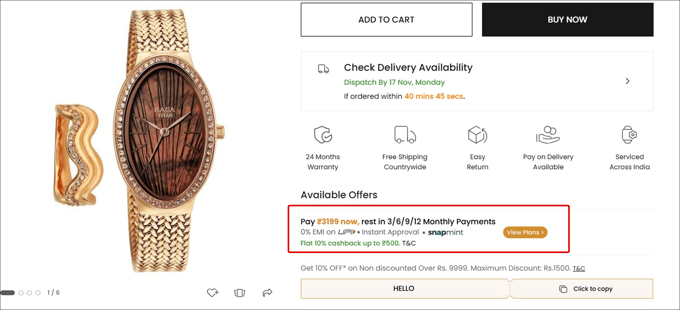
Looking to offer reduced cost or no cost EMI to your buyers? Connect with Snapmint to enhance your conversion ratio.

3. Guest Checkout to Uplift Checkout Conversions
Requiring consumers to sign up for an account before purchase adds additional stages in the user’s purchasing experience. Guest checkout can decrease friction, particularly for first-time or casual shoppers.
This not only allows consumers to finish the transaction swiftly but also results in improved conversion rates for your business.
4. Implement Single-Page or One-Click Checkout
Less steps means less drop-offs.
If you make the buyer go through many pages and hundreds of steps, chances are they will drop out at some point. Reduce the user’s decision time and cognitive strain by implementing a one-click or single-page checkout.
Good for returning consumers and impulse buyers.
5. Provide Multiple Payment Options (Including Split Payments)
Some consumers have various tastes, some prefer wallets, some prefer UPI or cards.
Some clients may abandon the cart if their preferred mode of payment is not accessible. By providing them several payment options, you’re making sure no buyer is going to quit due to friction at checkout.
6. Use Autofill to Make Forms Simple
Long, repeated forms can annoy your shoppers. You can make the checkout process faster by minimizing the amount of fields and allowing the autofill to work (by browser or saved profile data).
This is especially handy on a cellphone where typing is a pain.
The forms should be easy to fill out so your shopper has a simpler time with the procedure. This will decrease the possibilities of their abandoning the cart in frustration.
7. Send Abandoned-Cart Reminders
Not all cart abandoners are lost causes. Sometimes, a small nudge is all a buyer with a ton of interest needs to make the deal.
Send tailored reminders to users through email, text message or WhatsApp to urge them to return and complete their transaction. We know that personalized follow-ups are more likely to result in improvement for the person.
8. Display Security Badges and Earn Trust
Many shoppers are concerned about fraud and data security while shopping online.
You may increase the shoppers' confidence and lessen their uncertainty at the last step by displaying trust signals such as SSL certificates, safe payment gateways and customer reviews.
9. Show All Costs Upfront
Drop-offs happen in the end because shoppers are annoyed about hidden prices like shipping, taxes and handling that show up at the last step. Being upfront from the start creates trust, eliminates unpleasant surprises, and increases checkout completion.
10. Make Mobile Checkout Simpler to Increase Checkout Conversion
These days, most individuals shop on their phones. Problems arise if your checkout page is hard to use on mobile devices, takes too long to load, or requires zooming in and out. Create an easy-to-use mobile site, add clear call-to-action buttons, and have a mobile-friendly layout and you can encourage more users to buy on your mobile site.
11. Use Progress Indicators
Users feel more in control when they can see how many steps are left (e.g. Shipping → Payment → Confirmation). It removes ambiguity and pushes them to complete the process. This is a good technique to enhance the cart conversion rate.
12. Offer Discounts & Free-Shipping Thresholds
You can motivate consumers to add additional goods to their basket or complete the purchase by offering a minimum spend for free delivery or an instant discount at checkout. Combine it with easy EMI alternatives, and you would end up increasing your AOV and reducing cart abandonment. Yes, it is that simple!
13. Recommend & Personalize Appropriate Products
Tailoring product suggestions to the user’s basket or browsing history helps users find more value in their order. It upsells the size of the basket, lets the customer believe that the experience is individualized, and improves upsell and conversion.
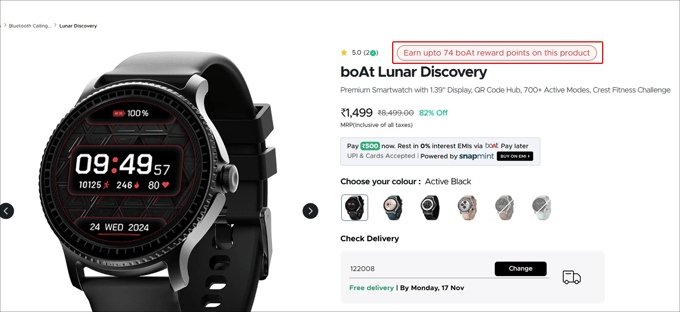
14. Loyalty Points
A loyalty program can really make a difference in checkout conversion. Offer your loyalty perks at the point of purchase. Example:
-
- Display the points a consumer will receive from their current purchase on the checkout page itself.
- Use tier-based rewards that rise with cart value to drive more spending and increase sign-ups.
- You may also incentivize users to join your loyalty program through your mobile application by offering exclusive app-only rewards and benefits.
15. Highlight the delivery date
The key to enhancing your checkout conversion rate is clear communication. Make sure your customer understands the expected date of delivery.
It would be even better if the consumer could choose their delivery date.
Give options for the delivery date, e.g. free delivery after 7 days paid quick delivery after 4 days, etc.
16. Add samples
Never underestimate the power of free things! Allow your shoppers to add free samples (or for a nominal payment like 1 rupee) at the checkout stage.
Shoppers are more likely to finalize the purchase when they see they are receiving a little something extra for free.
17. Reduce distractions for e-commerce checkout optimization
A busy checkout page can distract shoppers from finishing their transaction. A tidy checkout page helps your clients stay focused on finishing the transaction.
Eliminate unwanted pop-ups, links and banners.
Do not suggest off-topic suggestions.
.png?width=1700&height=616&name=Group%201597882553%20(1).png)
Quick Checkout Process Optimization Checklist
Checkout Process Optimization AreaDone?
Guest checkout enabled ☐
Autofill on all form fields ☐
All costs shown upfront ☐
Trust badges visible at payment step ☐
Mobile checkout tested on 3+ devices ☐
Progress indicator present ☐
Abandoned cart reminders set up ☐
EMI/split payment options available ☐
Conclusion: Increase Your Conversion Rate Using Snapmint
Snapmint helps boost your brand’s conversion rate by eliminating one of the major hurdles to online buying: price. This makes it easier for clients without credit cards to buy high-value products by offering quick EMI choices at checkout. Shopware’s ease and flexibility of shopping helps reduce cart abandonments and gives reluctant shoppers the confidence to purchase.
Snapmint has optimized the checkout conversion rates for India’s top D2C brands.
But don’t just take our word for it. Hear from our clients::
- Titan saw a 17% increase in their website conversion rate after Snapmint integration. Kuldeep Mohd, the Business and Product Head of Titan stated, “Snapmint has significantly accelerated our digital performance, driving a 20% increase in AOV, a 17% uplift in both website conversion and add-to-cart rates, and capturing a 13% wallet share in overall GMV. It's been a key growth lever for Titan."
Superkicks, another client, saw a 15-18% increase in conversion rates after partnering with Snapmint. Check out Superkicks’ full growth trajectory on Superkicks checkout conversion case study.
FAQs: