




For D2C brands, the solution is not necessarily more discounts. It is payment flexibility.
When customers cannot find a payment method that fits their purchasing power, brands can lose a sale after already spending on customer acquisition. The right payment mix can therefore influence conversion, AOV, cart abandonment and the efficiency of every rupee spent to acquire a customer.
Customers today have different payment preferences depending on the product price, their cash flow, device, location and familiarity with digital payments. Someone buying a ₹500 skincare product may prefer UPI, while a customer purchasing a ₹15,000 mattress, smartphone accessory or fitness product may be more comfortable spreading the cost across monthly instalments.
This is why offering a single payment method is increasingly restrictive for D2C brands.
India's digital payment ecosystem has expanded rapidly, with UPI becoming a dominant payment method. UPI processed around ₹29.87 trillion in transactions in July 2026 alone. But the bigger opportunity for D2C brands is the gap between UPI's reach and access to flexible credit: customers may be comfortable using UPI but still lack a payment option that lets them spread the cost of higher-value purchases.
At the same time, many customers may want a higher-value product but lack the credit access needed to pay the full amount upfront. This is where payment flexibility can help D2C brands serve demand that may otherwise be lost at checkout.
Here are seven payment options Indian D2C brands should consider offering in 2026.
7 Flexible Payment Options In 2026
1. UPI Payments
UPI should be one of the fundamental payment options for an Indian D2C website.
Customers are already familiar with UPI through apps such as Google Pay, PhonePe, Paytm and their bank applications. The payment process is generally quick, mobile-friendly and does not require customers to manually enter lengthy card details.
For brands, UPI can be particularly important because a significant share of Indian ecommerce traffic comes from mobile devices.
Why D2C brands should offer UPI
UPI can:
- Reduce payment friction and speed up mobile checkout
- Support prepaid purchases without requiring card details
- Reach customers who primarily use UPI or do not use credit cards
- Support customers across metros, Tier 2 and Tier 3 markets
UPI adoption is also extending beyond India's largest metros. Research from Amazon Pay and Kearney found that digital payment adoption has been growing in smaller towns as well, with digital transaction volumes increasing in FY25.
Best practice
Don't hide UPI behind multiple checkout steps.
Display UPI prominently alongside other popular payment methods and, where possible, support familiar UPI apps and QR-based payment flows.
However, UPI alone does not solve the affordability problem.
But UPI alone doesn't solve the upfront cost. A customer can be fully comfortable paying via UPI and still not want to pay ₹10,000 in one shot..
2. Credit and Debit Cards
Cards remain an important checkout option because they give eligible customers access to existing credit, rewards and cashback while providing a familiar payment experience. For D2C brands, keeping cards available can help protect conversions among customers who prefer to use their available card limit for higher-value purchases.
Credit cards can also become particularly relevant for higher-value purchases where customers are accustomed to using credit rather than paying directly from their bank account.
Why cards still matter for D2C brands
Cards can provide:
- Familiarity for existing card users
- Access to credit
- Cashback and reward opportunities
- International payment capabilities for eligible customers
- A convenient option for high-value transactions
For brands selling premium products, subscriptions or higher-ticket categories, cards should remain part of the payment mix. The business risk is relying on card-based credit or EMI as the only route to higher-ticket purchases, because that can exclude customers without access to credit cards.
Limitation
Card payments should not be treated as the only way to provide credit or instalment flexibility.
Credit card penetration remains relatively limited compared with the scale of India's UPI ecosystem. Outlook Money’s 2026 analysis notes that only a small proportion of Indian consumers have access to credit-card EMI, creating an affordability gap for shoppers without credit cards.
Snapmint operates in a market where credit access remains a major barrier to online purchases. With only around 5% of India’s population having access to credit cards, card-based EMI excludes a large majority of potential customers. This creates a clear opportunity for Snapmint to bridge the affordability gap by enabling non-credit-card users to access EMI, helping D2C brands reach a wider customer base and improve conversions on higher-value purchases. This means a D2C brand that offers only card-based EMI may still exclude a large group of potential customers.
3. No-Cost EMI
For products with higher average order values, No-Cost EMI can be one of the strongest affordability tools available at checkout.
Instead of asking a customer to pay ₹12,000 immediately, an EMI option can present the purchase as a series of smaller payments.
For example:
Product price: ₹12,000
Traditional checkout: Pay ₹12,000 today
3-month EMI: Approximately ₹4,000 per month, subject to the applicable EMI structure
The second presentation can make the same product feel significantly more manageable.
Products where EMI can work particularly well
No-Cost EMI can be useful for:
- Electronics
- Furniture
- Mattresses
- Fitness equipment
- Premium fashion
- Beauty devices
- Home appliances
- Jewellery
- Lifestyle products
- Higher-value wellness products
Why EMI matters for D2C brands
EMI can help brands:
- Increase access to higher-priced products for customers
- Encourage consideration of premium variants and potentially increase AOV
- Reduce price-related checkout hesitation without relying solely on discounts
- Give customers an alternative to paying the entire amount upfront
The important point is to communicate EMI before the customer reaches the final payment screen. Add an EMI widget to the product detail page (PDP) and relevant listing/collection pages so customers see the monthly payment option while evaluating the product, rather than discovering it only at checkout.
If the customer only discovers EMI at the last stage, much of its psychological value is lost.
4. Cardless EMI and EMI on UPI
If EMI is useful, limiting it to credit card holders can significantly reduce its reach.
This is where cardless EMI and EMI on UPI can provide another layer of flexibility.
A customer does not necessarily need to own a credit card to want to purchase a higher-value product through instalments.
Cardless EMI can therefore bridge the gap between:
"I want this product"
and
"I don't want to pay the entire amount today."
Why cardless EMI matters in India
It can help brands reach customers who:
- Primarily use UPI
- Do not own a credit card
- Prefer monthly instalments
- Are comfortable with digital verification and UPI-based repayment
This is particularly relevant for brands targeting younger consumers and shoppers beyond India's largest metropolitan markets.
Example
Consider a customer looking at a ₹9,000 product.
Without EMI:
₹9,000 today
With a suitable 3-month EMI option:
₹3,000 per month
The product hasn't become cheaper.
The payment has simply become more manageable.
That distinction is important because flexible payment options can improve affordability without requiring the brand to permanently reduce its product price.
5. Buy Now, Pay Later
Buy Now, Pay Later (BNPL) allows customers to purchase immediately while paying according to the repayment structure offered by the provider.
Depending on the provider and product, this could involve paying later or dividing the purchase into multiple instalments.
For D2C brands, BNPL can be useful when the biggest checkout barrier is immediate payment rather than lack of product interest.
Why customers use BNPL
Customers may choose BNPL because they:
- Want greater payment flexibility
- Prefer not to pay the full amount immediately
- Are managing monthly cash flow
- Want to make an unplanned but considered purchase
- Don't have access to traditional credit products
Why brands should consider it
BNPL can potentially:
- Reduce payment-related friction
- Improve affordability
- Help convert hesitant shoppers
- Increase accessibility for customers without traditional credit cards
- Support higher-value purchases
However, brands should carefully evaluate the provider's eligibility criteria, fees, settlement terms, customer experience and regulatory framework before adding BNPL.
The objective should be responsible affordability, not encouraging customers to spend beyond their means.
6. Cash on Delivery
It may seem counterintuitive to discuss Cash on Delivery when digital payments dominate ecommerce.
But COD continues to matter for certain Indian D2C businesses and customer segments.
Not every shopper is equally comfortable making an online prepaid payment, particularly when purchasing from a relatively new or unfamiliar brand.
COD can therefore function as a trust-building mechanism.
Why COD still matters
COD can help:
- First-time customers feel more comfortable
- Brands build trust in newer markets
- Reach customers who prefer paying after delivery
- Reduce payment barriers for certain customer segments
However, COD comes with a major business challenge:
RTO, or Return to Origin.
When a customer refuses or fails to accept a COD order, the brand may have already incurred shipping and handling costs.
Therefore, the objective should not necessarily be to eliminate COD completely.
Instead, brands should create a balanced payment mix.
For example:
UPI + Cards + EMI + COD
can give customers choice while allowing the brand to encourage prepaid and flexible-payment orders.
Brands can also use incentives, order verification and customer communication to improve COD quality.
7. Wallets and Alternative Payment Methods
Digital wallets may no longer dominate ecommerce payments in the same way they once did, but they can still be useful depending on the target audience and checkout ecosystem.
Customers may have balances, rewards or offers available through particular wallets or payment platforms.
Similarly, brands may consider other payment methods depending on their customer base and product category.
These could include:
- Digital wallets
- Net banking
- Bank-specific payment offers
- Prepaid payment incentives
- Payment links
- QR-based payments
- Other embedded payment solutions
How Should D2C Brands Choose the Right Payment Options?
Offering seven payment methods does not automatically create a better checkout.
The right payment mix depends on factors such as:
1. Average Order Value
A ₹700 product and a ₹25,000 product have very different payment requirements.
Lower-AOV products may perform well with UPI and cards, while higher-AOV products can benefit significantly from EMI or other affordability options.
2. Target Audience
A Gen Z-heavy brand may see strong adoption of UPI and mobile-first payment experiences.
A premium electronics brand may need cards, EMI and cardless financing.
A brand selling across Tier 2 and Tier 3 markets may benefit from a broader payment mix.
3. Product Category
Consider what customers are purchasing.
A premium mattress, laptop or fitness machine may require a very different payment strategy from a ₹500 beauty product.
4. Customer Trust
For newer D2C brands, COD can help reduce the trust barrier for first-time shoppers.
Once customers become familiar with the brand, prepaid payment options can become easier to encourage.
5. Checkout Experience
Every payment method should be easy to understand.
Customers should know:
- What they need to pay today
- Whether there is any additional cost
- How instalments work
- When future payments are due
- Whether they need a credit card
- Whether eligibility requirements apply
The right combination depends on the brand.
A D2C brand should avoid adding every available payment method simply to make its checkout look comprehensive.
Too many choices can create unnecessary complexity.
The goal should be relevant flexibility, not payment clutter.
Where Should D2C Brands Display Flexible Payment Options?
Payment flexibility should not be introduced only at checkout.
By that point, the customer may already have developed price resistance.
Instead, affordability messaging should appear throughout the purchase journey.
Product Page
For higher-value products, consider displaying:
₹15,000
or ₹5,000/month with eligible EMI
This changes the customer's perception of the purchase before they reach the cart.
Cart Page
Reinforce the payment options before the customer proceeds to checkout.
For example:
Pay securely with UPI, cards or eligible EMI options.
Checkout Page
Prioritise the most relevant methods instead of presenting an overwhelming list.
A possible hierarchy could be:
- UPI
- Cards
- EMI / Pay Later
- COD
- Other payment methods
The exact order should be based on customer behaviour and conversion data.
Flexible Payments Are More Than a Checkout Feature
For D2C brands, payment flexibility should be treated as part of the broader conversion strategy.
Consider a customer journey:
Ad → Product Page → Add to Cart → Checkout → Payment
A brand can spend heavily on acquiring the customer and optimising the product page, but still lose the sale because the customer cannot find a comfortable way to pay.
This makes payment flexibility particularly important as customer acquisition becomes more expensive.
Instead of immediately offering another discount, brands can ask:
Is the customer rejecting the product, or are they rejecting the payment structure?
If the product is desirable but the upfront price is the barrier, flexible payment options may solve the problem more efficiently than a blanket discount.
How Flexible Payments Can Influence D2C Metrics
A well-designed payment strategy can influence several ecommerce metrics.
Conversion Rate
More relevant payment options can reduce payment-related friction and give customers a greater chance of finding a method they are comfortable using.
Average Order Value
EMI and pay-later options can make higher-priced products or upgrades feel more manageable.
Cart Abandonment
Customers who abandon because of upfront payment concerns may be more likely to complete a purchase when an appropriate flexible payment option is available.
Prepaid Order Share
UPI, cards and digital financing options can help brands encourage prepaid purchases rather than relying entirely on COD.
Customer Experience
Payment flexibility gives customers greater control over how they complete their purchase.
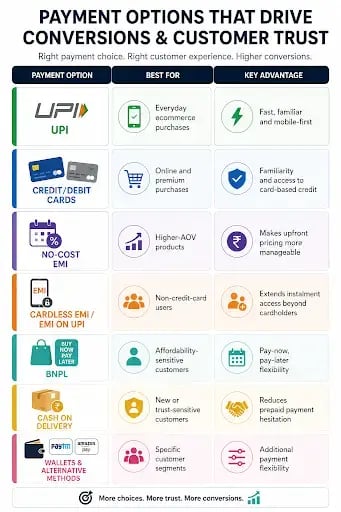
7 Payment Options at a Glance
How to Build a Better Payment Strategy in 2026
Instead of asking, "How many payment options should we offer?", D2C brands should ask:
"Which payment options remove the biggest barriers for our customers?"
A practical approach is to analyse:
- Your AOV
- Payment success rate
- Cart abandonment rate
- COD share
- RTO rate
- UPI vs card payment share
- EMI adoption
- Customer location
- New vs returning customer behaviour
- Payment-method-wise conversion rate
For example, if a brand has a ₹12,000 AOV and sees significant checkout drop-offs, adding another wallet may not solve the problem.
Introducing a transparent EMI or cardless EMI option could have a much greater impact.
The payment strategy should therefore be built around customer purchase behaviour and payment access, not simply the number of integrations available.
Conclusion: Make Payment Flexibility a Growth Lever with Snapmint
In 2026, Indian D2C brands need to think beyond simply accepting payments. The bigger opportunity is to make the purchase easier to afford.
UPI can deliver convenience. Cards provide familiarity. COD can build trust. But for higher-value purchases, EMI and pay-later options can address a different problem: the customer's ability to pay the entire amount upfront.
This is where Snapmint Business can fit into a D2C brand's payment strategy.
The strongest D2C checkout isn't the one with the most payment methods — it's the one that removes the specific friction costing that brand sales. For high-AOV categories, that's often upfront price. Snapmint addresses this directly: 0% EMI on UPI across 3, 6 and 9-month tenures, no credit card required, with merchants settled within T+2. If the upfront price is quietly capping your conversion rate, this is worth testing against your current checkout.
Ultimately, the strongest D2C checkout is not necessarily the one with the most payment methods. It is the one that gives the right customer the right way to pay at the right moment.
For brands selling products where upfront price can become a conversion barrier, adding a flexible EMI option such as Snapmint can turn affordability from a checkout obstacle into a potential growth lever.
.png?width=1700&height=616&name=Group%201597882553%20(1).png)
Frequently Asked Questions