




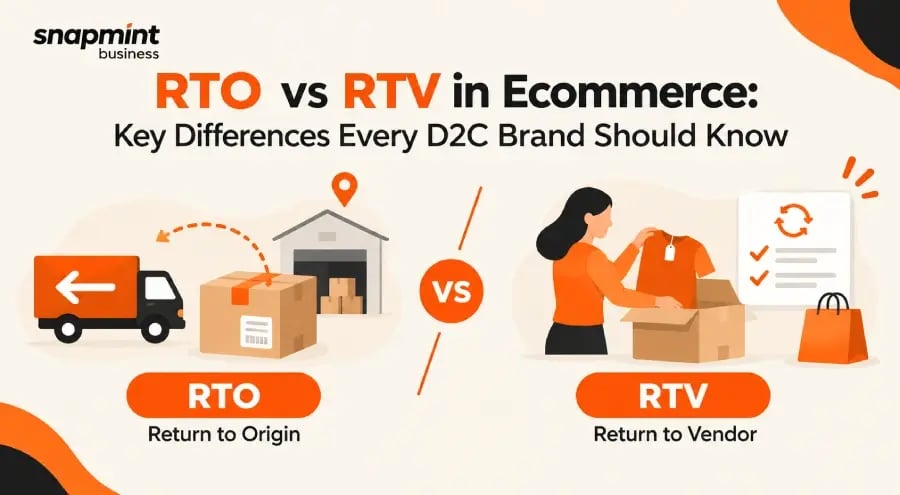
Key Takeaways
- RTO and RTV may both involve products moving backwards, but they represent two very different ecommerce problems.
- RTO is primarily about failed customer fulfilment.
- RTV is primarily about supplier and inventory management.
- For D2C brands, controlling both requires different strategies. RTO reduction depends on better customer verification, payment choices, address accuracy, delivery communication and NDR management. RTV reduction depends on stronger vendor agreements, quality control, inventory checks and supplier performance monitoring.
- The bigger objective is not simply to process returns faster. It is to understand why products are moving backwards in the first place.
- When D2C brands track RTO and RTV separately, identify their root causes and measure their financial impact, they can make better decisions around logistics, payments, suppliers and inventory, ultimately building healthier ecommerce unit economics.
Introduction
For D2C brands, getting an order out of the warehouse is only one part of successful ecommerce operations. What happens when that order does not reach the customer, or when products need to move back to a supplier, can have a direct impact on margins, inventory and cash flow.
Two terms that often create confusion are RTO and RTV.
RTO stands for Return to Origin and generally refers to a shipment that could not be delivered to the customer and is sent back to the seller. RTV stands for Return to Vendor, where goods are sent back to the supplier or vendor, typically because of defects, damage, excess inventory, quality issues or other agreed return conditions.
Although both involve products moving backwards through the supply chain, they are fundamentally different operational events.
For an Indian D2C brand, understanding the difference is important because RTO is primarily a fulfilment and customer-delivery problem, while RTV is primarily a supplier and inventory-management process.
RTO vs RTV: At a Glance
|
Factor |
RTO |
RTV |
|
Full form |
Return to Origin |
Return to Vendor |
|
Meaning |
Undelivered order returns to the seller |
Inventory is returned to the supplier/vendor |
|
Usually occurs |
Before successful customer delivery |
After stock has been received from the vendor |
|
Primary parties |
Customer, courier and seller |
Seller and vendor/supplier |
|
Common trigger |
Failed delivery, COD refusal, incorrect address |
Defective, damaged, excess or non-compliant stock |
|
Main concern |
Logistics cost and lost sale |
Inventory recovery and supplier settlement |
|
Customer received product? |
No |
Usually not relevant to the customer transaction |
|
Main solution |
Reduce delivery failures |
Improve supplier quality and inventory controls |
What Is RTO in Ecommerce?
RTO, or Return to Origin, occurs when an ecommerce shipment cannot be successfully delivered to the customer and is sent back to the seller. Understandingrto in e commerce is important for D2C brands because it helps them identify the causes of failed deliveries and build processes to reduce avoidable returns. Amazon Shipping defines RTO as a situation where a shipped order fails to reach the customer and comes back to the seller. Amazon Shipping defines RTO as a situation where a shipped order fails to reach the customer and comes back to the seller.
For example:
A customer places a ₹2,000 COD order on a D2C website.
The brand:
- Receives the order.
- Packs the product.
- Hands it to the courier.
- Courier attempts delivery.
- Customer is unavailable or refuses the order.
- Delivery attempts fail.
- The parcel is sent back to the brand.
That shipment becomes an RTO.
Why Does RTO Happen?
RTO can happen for several reasons, and not all of them are within the seller's direct control.
Common causes include:
- Customer refuses a COD order
- Customer changes their mind after placing the order
- Incorrect or incomplete address
- Incorrect pincode
- Customer is unavailable during delivery attempts
- Phone number is unreachable
- Delivery area is not serviceable
- Customer does not have cash available for COD
- Customer has already purchased the product elsewhere
- Fake or low-intent orders
- Delivery delays
- Poor communication about delivery status
What Is RTV in Ecommerce?
RTV stands for Return to Vendor.
It refers to the process of sending products back to the supplier or vendor from whom the business sourced them.
Unlike RTO, RTV is generally an inventory and supplier-management process, rather than a failed customer delivery.
For example, imagine a D2C skincare brand purchases 1,000 units from a manufacturer.
During a quality inspection, the brand discovers that 80 units:
- Have damaged packaging
- Have manufacturing defects
- Do not meet agreed specifications
- Have incorrect labels
- Have quality-control issues
The brand may send those units back to the supplier under the applicable vendor agreement.
That process is RTV.
RTV can involve products being returned for a refund, replacement, repair or supplier credit, depending on the commercial agreement.
RTO vs RTV: The Key Difference
The easiest way to remember the distinction is:
RTO is a failed customer delivery. RTV is a supplier return.
Consider these two scenarios.
Scenario 1: RTO
Brand → Courier → Customer → Failed delivery → Brand
The product never reaches the customer successfully.
Scenario 2: RTV
Vendor → Brand → Quality/inventory issue → Vendor
The brand sends inventory back to the supplier.
This difference affects everything from accounting and logistics to customer service and inventory planning.
RTO vs RTV: Detailed Comparison
1. Point in the Supply Chain
RTO typically happens after a customer order has been dispatched.
RTV happens within the supplier-to-brand inventory cycle.
RTO
Customer places an order → Brand ships → Delivery fails → Product returns to brand.
RTV
Vendor supplies inventory → Brand identifies an issue → Product returns to vendor.
2. Primary Reason
The reasons behind RTO and RTV are very different.
RTO is usually caused by delivery failure
For example:
- Wrong address
- Customer unavailable
- COD refusal
- Non-serviceable location
- Failed delivery attempts
RTV is usually caused by inventory or supplier-related issues
For example:
- Product defects
- Damaged inventory
- Incorrect quantity
- Incorrect product specification
- Quality-control failure
- Overstock, where the supplier agreement permits returns
- Product recalls
- Expired or short-dated stock
The distinction matters because the solution needs to address the root cause, not simply the return itself.
3. Who Is Involved?
RTO typically involves:
- Customer
- D2C brand
- Courier or logistics provider
- Delivery executive
RTV typically involves:
- D2C brand
- Manufacturer
- Supplier/vendor
- Warehouse or procurement team
- Finance team
This means RTO requires closer coordination between customer experience and logistics, while RTV requires stronger coordination between procurement, warehouse, finance and suppliers.
4. Who Bears the Cost?
The financial impact can also be different.
With RTO, the seller may incur:
- Forward shipping charges
- Reverse shipping charges
- Packaging costs
- Handling costs
- Customer acquisition costs
- Inventory holding costs
- Potential product damage
- Lost revenue
With RTV, the cost depends heavily on the supplier agreement.
A vendor may:
- Provide a replacement
- Issue a credit note
- Refund the purchase amount
- Repair the product
- Absorb transportation costs
- Share the cost with the brand
Therefore, D2C brands should clearly define RTV terms in vendor contracts.
5. Impact on Customer Experience
RTO can directly affect the customer experience because it involves a customer order.
A customer may:
- Wait for an order that never arrives
- Receive multiple delivery attempts
- Cancel after a delay
- Lose trust in the brand
- Decide not to reorder
RTV, on the other hand, is generally invisible to the end customer.
A customer does not necessarily know that a batch of products was returned to the manufacturer.
However, RTV can still indirectly affect customers if supplier issues result in:
- Stock shortages
- Delayed fulfilment
- Product unavailability
- Order cancellations
- Quality problems
6. Impact on Inventory
RTO temporarily ties up inventory while the product is travelling back through the logistics network.
Once the product reaches the warehouse, the brand needs to determine whether it can be:
- Restocked
- Repackaged
- Sold again
- Discounted
- Repaired
- Written off
RTV removes the inventory from the brand's stock and sends it back to the supplier.
Therefore, RTV can potentially help a brand recover value from inventory that it cannot or does not want to sell.
7. RTO Is Usually a Customer-Delivery Problem RTV Is a Supplier Problem
This is perhaps the most important distinction for D2C teams.
If RTO is increasing, investigate:
"Why are our customers not accepting or receiving orders?"
If RTV is increasing, investigate:
"Why are we receiving inventory that cannot be sold?"
The answers will lead to completely different corrective actions.
How to Reduce RTO for Your D2C Brand
Reducing RTO is primarily about preventing failed deliveries before they happen.
1. Improve Address Validation
Incorrect or incomplete addresses are a common cause of failed delivery.
Use address validation and pincode checks at checkout wherever possible.
Make it easy for customers to enter:
- House number
- Street/locality
- Landmark
- City
- State
- Pincode
- Phone number
2. Confirm High-Risk COD Orders
COD can increase exposure to RTO because the customer has not made a prepaid financial commitment.
Brands can use:
- SMS confirmation
- WhatsApp confirmation
- IVR calls
- Order confirmation calls
- OTP-based verification
The objective is to identify customers who no longer want the product before the order is dispatched.
3. Encourage Prepaid Payments
If a customer is willing to pay online, prepaid orders can reduce the specific risk associated with COD refusal.
Brands can test incentives such as:
"Get ₹100 off on prepaid orders."
or
"Free shipping on prepaid orders."
The exact incentive should be evaluated against the cost of RTO. Beyond prepaid discounts, brands can also offer flexible payment options through an emi solution, giving customers an alternative to COD while making higher-value purchases more manageable.
For Shopify-based brands, choosing the right payment infrastructure can also influence the checkout experience. Brands evaluating the best payment gateway for Shopify India should consider payment flexibility, checkout experience and the needs of their target customers.
4. Improve NDR Management
NDR means Non-Delivery Report.
When a courier cannot deliver an order, brands should not simply wait for the shipment to automatically become RTO.
A proactive NDR process can involve:
- Identifying the failed delivery.
- Contacting the customer.
- Understanding the reason.
- Confirming availability.
- Updating delivery instructions.
- Requesting another delivery attempt where appropriate.
The faster the brand responds, the more opportunity it has to recover the order.
5. Analyse RTO by Pincode
A high overall RTO rate can hide specific geographic problems.
For example:
|
Pincode Group |
RTO Rate |
|
Metro pincodes |
6% |
|
Tier 2 cities |
12% |
|
Tier 3 cities |
18% |
|
High-risk pincodes |
29% |
This type of analysis can help brands introduce different COD rules or courier strategies for high-risk locations.
6. Improve Delivery Communication
Customers are less likely to miss deliveries when they know:
- When the order will arrive
- Which courier is delivering it
- How much they need to pay for COD
- How they can contact the delivery partner
- What happens if they miss the first attempt
Automated WhatsApp and SMS updates can help keep customers informed throughout the delivery journey.
How to Reduce RTV
Reducing RTV requires a different strategy.
1. Set Clear Vendor Quality Standards
Vendor agreements should clearly define:
- Product specifications
- Packaging requirements
- Quality standards
- Acceptable defect rates
- Labelling requirements
- Inspection procedures
- Replacement timelines
- Credit-note process
- Transportation responsibility
2. Conduct Quality Checks Before Inventory Goes Live
Do not wait until products reach customers to identify supplier quality issues.
Warehouse teams should inspect incoming inventory for:
- Physical damage
- Incorrect products
- Missing components
- Packaging issues
- Labelling errors
- Manufacturing defects
- Quantity discrepancies
3. Track RTV by Vendor
Create a vendor-level RTV report.
For example:
|
Vendor |
Units Received |
RTV Units |
RTV Rate |
|
Vendor A |
10,000 |
120 |
1.2% |
|
Vendor B |
8,000 |
640 |
8.0% |
|
Vendor C |
12,000 |
180 |
1.5% |
Vendor B clearly requires further investigation.
The problem could be related to manufacturing, packaging, transportation or quality-control processes.
4. Identify Repeated Defects
If the same defect repeatedly causes RTV, the solution should not simply be another return.
For example:
RTV → Replacement → Same defect → RTV
This creates unnecessary operational costs.
Instead, the brand should identify the root cause with the supplier and correct the production or packaging process.
RTO vs RTV: Which Is More Expensive?
There is no universal answer because the cost depends on the product, shipping model, vendor agreements, AOV and operational setup. For brands looking to increase aov, understanding how payment options and order economics interact with logistics costs is particularly important.
However, the cost structure is different.
RTO can involve:
Forward freight + reverse freight + packaging + handling + CAC + lost revenue
RTV can involve:
Reverse freight + handling + inspection + inventory disruption
But RTV may allow the brand to recover value through:
- Supplier credit
- Replacement stock
- Refund
- Repair
- Commercial adjustment
RTO, by contrast, can result in a completed delivery never occurring at all.
That is why RTO is particularly important for COD-heavy D2C businesses. Recent Indian ecommerce research continues to identify COD as a major contributor to RTO, with reported RTO levels varying significantly by category and customer segment.
RTO vs Customer Return vs RTV
Another common source of confusion is treating RTO, customer returns and RTV as the same thing.
They are not.
|
Type |
What Happens? |
Customer Received Product? |
Main Reason |
|
RTO |
Undelivered parcel goes back to seller |
No |
Failed delivery |
|
Customer Return |
Delivered product comes back to seller |
Yes |
Size, quality, preference, defect, etc. |
|
RTV |
Inventory goes back to supplier |
Usually not relevant |
Supplier/product/inventory issue |
This distinction is important because each requires a different operational workflow.
How RTO and RTV Affect D2C Profitability
A D2C brand can have strong sales and still struggle with profitability if it ignores reverse logistics.
Consider a simplified example.
A brand generates:
₹10 lakh in monthly sales
But it also has:
- High COD dependence
- 15% RTO
- High reverse shipping costs
- Repeated supplier defects
- Slow inventory reconciliation
The headline revenue figure may look healthy.
But a significant amount of money can be tied up in logistics, inventory and failed fulfilment.
This is why D2C brands should monitor contribution margin after returns and logistics, rather than looking at revenue alone.
RTO is particularly important because the brand can incur shipping costs even though the sale never becomes a completed customer transaction.
RTO vs RTV: A Simple Decision Framework
When a product moves backwards through your supply chain, ask three questions:
Question 1: Did the customer ever receive the product?
No → Investigate RTO.
Yes → It is likely a customer return.
Question 2: Is the product being sent back to the supplier?
Yes → Investigate RTV.
Question 3: Why is it moving backwards?
Failed delivery → RTO
Customer dissatisfaction/return policy → Customer return
Supplier/product/inventory issue → RTV
This simple framework can help ecommerce teams classify returns correctly and assign them to the right workflow.
RTO vs RTV: Key Differences Every D2C Brand Should Remember
|
Factor |
RTO |
RTV |
|
Full form |
Return to Origin |
Return to Vendor |
|
Trigger |
Failed customer delivery |
Supplier/inventory issue |
|
Direction |
Customer → Brand |
Brand → Vendor |
|
Main problem |
Fulfilment |
Supply chain |
|
Common cause |
COD refusal, address issue, customer unavailable |
Defect, damage, overstock, non-compliance |
|
Main cost |
Forward + reverse logistics |
Reverse logistics + handling |
|
Customer impact |
Direct |
Usually indirect |
|
Main KPI |
RTO rate |
RTV rate |
|
Primary solution |
Better delivery success |
Better vendor quality and inventory management |
Conclusion
RTO and RTV may both involve products moving backwards through the ecommerce supply chain, but the underlying problems are very different. RTO is largely a customer fulfilment and payment-related challenge, while RTV is more closely connected to supplier quality and inventory management. For D2C brands, reducing both requires identifying the root cause, tracking the right metrics and building processes around prevention rather than simply managing returns after they occur.
For RTO specifically, payment choice can play an important role in improving order quality and reducing the risk associated with COD-heavy transactions. This is where flexible payment solutions such as Snapmint can support D2C brands. By offering customers options such as Pay in 3 and other flexible payment solutions, brands can make purchases more manageable without relying entirely on traditional COD.
.png?width=1700&height=616&name=Group%201597882553%20(1).png)
Frequently Asked Questions