
.webp?width=1400&height=638&name=15-proven-strategies-to-minimize-return-to-origin-for-D2C-brands%20(1).webp)
Key Takeaways:
- RTO = lost sales + extra costs of reverse logistics + blocked inventory.
- RTO or Return to Origin impacts margins and profitability, which is why RTO reduction is a major pain point for e-commerce, retail, and D2C brands.
- How can D2C brands minimize RTO losses? Offering affordability through BNPL options, EMI on UPI, and multiple payment options can reduce dependence on COD, hence reducing RTO rates.
- Use AI/ML to detect fraudulent orders and fake customer profiles. You can even set order limits for new COD customers.
- Reducing RTO basically means more profit for the company. So, try these proven strategies to reduce RTO in e-commerce.
Introduction
Every E-Commerce business celebrates a new order.
But what if the product ordered does not reach the customer and returns back to your warehouse?
Well, that is when RTO in E Commerce comes into play.
Return to Origin has a greater impact than imagined or perceived, like reduced earnings for online retailers, particularly D2C companies that rely significantly on Cash on Delivery (COD). You spend money on customer acquisition, product packing, forward shipping, and reverse logistics, yet you never get paid as the customer did not receive the order.
RTO rates for many Indian e-commerce companies are between 20% and 40%; COD-heavy categories like fashion, jewellery, beauty, and accessories frequently see even higher figures.
This detailed guide will take you through what is Return to Origin (RTO), why it occurs, how it affects your company, and 15 strategies on how to reduce RTO in e-commerce.
What Is RTO Or Return To Origin
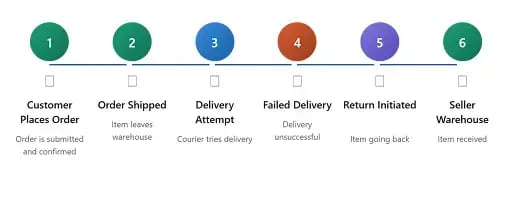
RTO (Return to Origin) in ecommerce occurs when an order is shipped but cannot be delivered to the customer and is returned back to the seller's warehouse. Common reasons include customer refusal, incorrect addresses, failed delivery attempts, and fake COD orders.
An RTO in e-commerce takes place prior to a successful delivery, as opposed to a typical product return where the customer receives the item and then returns it.
For Example:
- A consumer uses Cash on Delivery to purchase a silver bracelet.
- The order is shipped by the vendor.
- Delivery is attempted by the courier.
- The client is unreachable or declines to receive it.
- The package is brought back to the warehouse.
- That turns into an RTO order.
Why Is RTO A Major Problem For Online Brands?
A common issue in e-commerce is high RTO, which occurs when an order is returned to the vendor. COD orders contribute to 60–70% of RTO incidents in India.
When an RTO occurs, the order doesn’t just fail; it creates double costs. The seller pays for both forward and reverse logistics, loses potential revenue, and has inventory stuck in transit until it returns.
In short, RTO = lost sales + extra costs + blocked inventory.
That’s why reducing return to origin is critical for protecting margins and improving profitability in e-commerce.
Let’s understand with an example
Let’s say you sell a ₹1,000 product with free shipping.
Forward shipping cost: ₹70
Reverse shipping cost: ₹70
Packaging + handling: ₹30
Total logistics cost: ₹170
Now, if the order gets returned to origin (RTO) because the customer refused delivery or provided the wrong address,
You lose ₹1,000 in sales revenue.
You spend ₹170 on logistics, even though no sale was made.
Your inventory stays blocked for 10–15 days until the product comes back.
Total Loss= 1000 (lost revenue) + 170 (direct loss) + inventory blocked.
When this happens at scale, let’s say, 100 RTO orders in a month, your business loses: (₹170 × 100) = ₹17,000 in logistics + ₹1,00,000 in lost revenue = ₹1,17,000 total impact.
By integrating Snapmint, you not only reduce your RTO, but also increase Add-to-Cart, AOV, and conversions.
COD vs Prepaid: Comparison in RTO Rates
Delivery success rates can be greatly impacted by payment methods. Cash on Delivery and prepaid purchases have different customer commitment levels, thus knowing how each affects RTO in ecommerce will help you make more informed checkout and payment choices.
|
Factor |
COD (Cash on Delivery) |
Prepaid Order |
|
Average RTO Rate |
25 - 40% (higher in niche product) |
2 - 3% |
|
Financial Risk for Seller |
High |
None Or Minimal |
|
Loss Of Each RTO |
Around 20% of total revenue |
- |
Understanding Key Reasons Behind RTO in E-commerce
RTO in E commerce is not caused by a single reason. It is typically caused by a mismatch between customer intent, operational effectiveness, and delivery execution.
Thus, reducing Return to origin rates requires figuring out where things break down, from buyers losing purchase intent to delivery-related issues at the last mile.
RTO in ecommerce causes can be broadly divided into two categories
- Consumer-driven: Things that come up after the order is placed but before the consumer receives the product.
- Issues Related to Delivery: Problems with shipping, delivery efforts, and last-mile execution.
By building a deeper understanding on the above 2 factors companies can develop focused solutions by comprehending both categories.
Consumer Driven Reasons Affecting RTO
Buyer behaviour and buying intent are the root causes of these problems. D2C businesses can frequently lessen them through improved checkout procedures and consumer validation techniques because they happen prior to the delivery process being finished.
1. Consumer Changes Mind After Placing An Order
Sometimes impulsive orders are placed by customers who later change their minds. When purchasing decisions are influenced by urgency, such as during flash sales, discounts, or limited-time offers, this behaviour is more prevalent.
2. Consumers Do Price Comparisons On Various Platforms
Product comparisons between several platforms are common among online customers. After placing a purchase, consumers can simply refuse the package at the door if they find a lesser price.
3. Low To No Commitment Towards COD Orders
Some customers make Cash on Delivery orders with little intention of making a purchase because there is no advance payment required. Rejection and cancellation rates may rise if there is no money commitment involved.
Delivery Related Reasons Affecting RTO
These problems occur during last-mile delivery and shipping. These areas are typically easier to control through operational enhancements than consumer behaviour.
1. Inaccurate or Missing Address Data
Finding the consumer may be challenging due to missing locations, incorrect pin codes, or typos. Delivery attempts may fail due to even minor address problems.
2. Unavailable Customer During Delivery
Repeated delivery failures may result from delivery partners showing up when clients are at work, travelling, or unable to answer calls.
3. Delays in Delivery
Long delivery times can make customers less interested and trusting.
Gifts, fashion items, and event-related purchases are examples of time-sensitive expenditures that are especially susceptible.
4. Inadequate Communication During Delivery
Customers may start to worry about the status of their package if they do not receive timely order updates. Refusal or cancellation may result from a lack of visibility.
How To Calculate RTO Rate?
The following calculation can be used to get your RTO rate:
RTO Rate = (Total RTO Orders ÷ Total Shipped Orders) × 100
For Example: Let's say that in a given month, your online store dispatched 2,000 orders and 300 orders were returned to the original location.
RTO Rate = (300 ÷ 2,000) × 100
RTO Rate: 15%
This indicates that 15 of every 100 sent orders were returned to your warehouse after failing to reach their intended recipients.
Why Should E-Commerce Brands Reduce RTO?
Return to Origin is much more than just an unsuccessful delivery for online retailers. Each RTO order sets off a series of extra expenses and operational difficulties that have a direct impact on business expansion and profitability. Implementing effective RTO solutions helps brands reduce unnecessary losses while improving operational efficiency.
Here are some reasons why e-commerce companies should prioritise lowering RTO:
1. Boosts Profit Margins
Forward shipping, reverse logistics, packaging, and warehouse handling fees are among the expenditures associated with each RTO order. Businesses can increase overall profitability and retain more revenue by lowering RTO.
2. Prevents Customer Acquisition Cost Wastage
Through marketing initiatives, influencer campaigns, and paid advertisements, brands make significant investments to acquire consumers. The money paid to obtain that customer frequently goes to waste without producing any revenue when an order becomes an RTO.
3. Enhances Cash Flow
Longer periods of capital and inventory lockup can result from high RTO rates. Faster order completion and more consistent cash flow are the results of lower RTO rates.
4. Improves the Client Experience
Customer satisfaction and confidence can be adversely affected by repeated delivery failures. Increasing delivery success rates makes purchasing more enjoyable and raises the likelihood of repeat business.
5. Makes Improved Inventory Management Possible
Items that are stuck in return cycles are not accessible to new buyers. Reduced RTO rates lessen stock disruptions and enhance inventory mobility.
6. Encourages Long-Term Business Development
Even a slight percentage increase in RTO can result in large losses if order volumes climb. Early RTO reduction enables companies to grow sustainably without incurring needless operating expenses.
In the end, lowering RTO is about more than just decreasing delivery errors; it's also about safeguarding income, enhancing customer satisfaction, and developing a more robust e-commerce enterprise.
Ultimately, reducing RTO is not just about minimizing delivery failures; it is about implementing the right RTO solutions to safeguard revenue, improve customer satisfaction, and build a stronger ecommerce business.
How Can I Reduce My Cash-On-Delivery Losses? RTO Solutions For COD
Cash-on-Delivery (COD) might result in increased RTO rates and revenue losses even while it helps boost conversions and draw in more clients. To reduce the losses on COD, business should:
- Concentrate on enhancing order quality and customer loyalty in order to lower COD-related losses.
- Cancellations and unsuccessful deliveries can be greatly decreased by using tactics including confirming high-value orders, encouraging prepaid payments, etc.
- Introducing partial COD, and providing prompt delivery updates.
Reducing RTO rates and increasing profitability can be achieved by taking proactive measures before shipping.
RTO Benchmarks By Product Category: How Does Your Industry Compare?
Not all e-commerce categories have the same RTO rates. The frequency with which orders are returned to the seller is greatly influenced by customer behaviour, average order value, payment options, and purchase intent.
For instance, impulsive purchases, frequent buying, and a strong reliance on Cash-on-Delivery sometimes result in higher RTO rates for fashion and clothing firms. However, due to higher purchase intent, areas like electronics and health products typically have lower RTO rates.
The following are representative RTO benchmarks found in India's main e-commerce categories:
|
Product Category |
Typical RTO Range |
Key Reasons |
|
Fashion & Apparel |
10–40% |
Size mismatch, impulse buying, multiple orders, high COD usage |
|
Jewellery & Accessories |
8–15% |
High COD dependency, price comparison, purchase hesitation |
|
Beauty & Personal Care (BPC) |
10–12% |
Shade mismatch, changing preferences, COD orders |
|
Electronics & Accessories |
8–15% |
Price comparison, fake orders |
|
Health & Wellness |
10–18% |
Delivery delays, lower urgency after purchase |
|
Home & Furniture |
15–30% |
Delivery complexity, expectation mismatch |
|
Kids & Toys |
15–22% |
Impulse purchases, seasonal demand |
Source: EshopBox
Your brand may have problems with customer intent, checkout process, delivery operations, or order quality if its Return to origin rate is much higher than the average for your category.
Compare your performance with benchmarks relevant to your category rather than the e-commerce sector as a whole.
For electronics, a 20% RTO rate could be alarming, but for a fashion company that relies heavily on COD, it might be somewhat typical. Instead of using the same approach for every product, D2C brands can develop specialised RTO solutions by comprehending these category-level trends.
15 Proven Strategies On How To Reduce Rto In E-Commerce (Strategies For Lower RTO)
Let’s get to the point. You know RTOs are eating up your margins, but how to reduce RTO in e-commerce? What can you do to reduce RTO charges? Well, with these 15 proven methods, you can reduce RTO rates and boost your profits.
Here are some strategies on How to reduce RTO losses for D2C brands:
1. Improve Address Accuracy at CheckoutIf incorrect addresses are the cause behind your return-to-origin costs, you can reduce RTO by improving address accuracy at checkout. Use address validation tools that auto-complete PIN codes, cities, and landmarks.
Send an address confirmation SMS/email right after order placement.
There are many ways to improve your checkout experience. Check out this blog to learn more about e-commerce checkout optimization.
2. Offer Multiple Payment OptionsImagine your customer uses CRED or PhonePe, instead of credit card and they resort to COD because their preferred payment is not available.
COD orders have a higher RTO rate compared to prepaid. So, enable UPI, EMI, and Pay Later to encourage customers to move away from COD.
By offering EMI on UPI, you can reduce COD orders and in turn, reduce RTO.
Also read: Snapmint is Now Live on Razorpay Checkout – Powering Smarter Conversions
3. Incentivize Prepaid OrdersProvide discounts, cashback, or loyalty points for prepaid orders. This way, you are giving your customer a reason to ‘not choose’ COD.
When you provide EMI options to your customers, it reduces the barrier of purchasing and increases payment flexibility, and allows them to pay some amount instead of the lump sum amount.
This reduces their dependence on COD when making high ticket purchases. Partner with EMI/BNPL providers like Snapmint so customers don’t cancel for affordability reasons.
5. Use Smart Order Confirmation SystemsCustomers sometimes place orders by mistake or change their mind.
Enabling an IVR/WhatsApp confirmation before dispatch can resolve this issue. Add a “Confirm Order” button via SMS/WhatsApp after checkout.
Allow easy order modification or cancellation before shipment to avoid unnecessary logistics costs. This will save any reverse logistics costs.
6. Analyze Customer Buying Behavior and Act on RTO DataRTO is often caused by repeat offenders or non-serious buyers.
A simple solution is to create a RTO risk score using AI/ML models based on past customer behavior.
Flag high-risk customers and restrict COD for them.
Prioritize loyal customers with faster delivery and more flexible payment options.
Implement predictive analytics to forecast RTO risk.
7. Invest in Fraud Prevention & Risk ManagementFake orders, prank COD bookings, and fraud inflate RTO costs.
Use AI fraud detection systems to spot unusual order patterns. Block suspicious IPs, duplicate phone numbers, and blacklisted customers.
Set order limits for new COD customers.
Tip: Multiple high-value orders from the same customer are potential red flags. Use fraud detection filters for suspicious COD orders.
8. Partner with Reliable 3PL & Logistics ProvidersWork with trusted delivery partners who have strong networks. Use NDR (Non-Delivery Report) management tools to quickly reschedule failed deliveries.
You can also incentivize delivery agents for first-attempt delivery success.
9. Reduce Delivery Times (Faster Fulfilment = Lower RTO)Did you know that long delivery windows often cause cancellations? Yes, when you give weeks to your customer to sit and think after placing the order, they might change their mind and cancel. In fact, longer delivery time also pushes customers to opt for offline or other shopping options if they need the product urgently.
What can you do to reduce the RTO due to this reason?
Enable hyperlocal delivery models for metro areas.
Invest in regional warehouses to cut down TAT (Turnaround Time).
Highlight “Fast Delivery” badges on product pages to set the right expectations.
10. Strengthen Returns & Refund Policies/ Offer Exchange instead of ReturnsSome RTOs happen because customers feel unsafe about refunds.
If you offer hassle-free returns & instant refunds for prepaid buyers, they would not choose COD as a safe option.
Educate customers via FAQ pages, social media, and emails about policies.
You can also offer exchange instead of return to reduce return rates.
11. Token Payments While OrderingIf you experience a high RTO rate, you can enable partial payment collection before dispatch (token advance), especially for higher AOV orders. This will ensure that the customer doesn't cancel their orders.
You can also increase your Average Order Value to increase your revenue and GMV. Check out the 14 proven ways to increase AOV for D2C brands.
12. Prioritize customer delivery preferencesAlways ask time slots, preferred courier, etc. from the customer to avoid returns. To go a step further, you can check customer availability before attempting delivery. This would ensure that the customer is available at the delivery address at the decided time.
13. Provide order tracking (visible real-time tracking for buyers)Enable customers to track their shipments through a live tracking link. Real-time visibility builds trust, reduces delivery-related queries, and improves overall post-purchase experience. This will keep them updated on the whereabouts of their order.
14. Improve product packagingSometimes, the product gets damaged in transit due to poor packaging, and the customer has no other choice but to return it. By investing in sturdy, tamper-proof, and weather-resistant packaging, you can minimize transit damage and significantly reduce Return to Origin (RTO) rates.
15. Optimize product descriptionsAn often overlooked but extremely important step is to give clarity to your customer in the first place. When the product descriptions are detailed and contain all the information needed by the customer to make an informed decision, they would be sure of their purchase and would not return the product.
Final Thoughts on How to Reduce RTO Charges
Reducing RTO is not about a single hack; it’s about combining tech, logistics, customer experience, and smart payments. Brands that implement these strategies not only protect margins but also boost customer satisfaction and repeat purchases.
.png?width=1700&height=616&name=Group%201597882553%20(1).png)
FAQs on RTO reduction