
.jpg?width=1703&height=923&name=Payment-Gateway-for-eCommerce%20(1).jpg)
Key Takeaways
- A payment gateway isn't just a way to collect money. It has a direct impact on conversion. Even improving your payment success rate from 85% to 92% can unlock revenue you're already spending to acquire.
- For Indian ecommerce, UPI has to work flawlessly. Fast payments, fewer redirects and high success rates make a noticeable difference at checkout.
- If your average order value is above ₹3,000, payment flexibility matters. Cardless EMI can help more customers complete their purchase, increase order values and reduce dependence on COD.
- Don't choose a payment gateway only because it has a lower MDR. Look at the overall cost per successful transaction, and if possible, test it with a small percentage of your traffic before making the switch.
- Keep an eye on payment metrics just like you track sales and ROAS. Reviewing payment success rates regularly and understanding why transactions fail often reveals opportunities to improve revenue without increasing marketing spend.
Payment infrastructure is one of the few growth levers that compounds quietly: every point of success rate, every prepaid order, every completed checkout is revenue earned from spend already made.
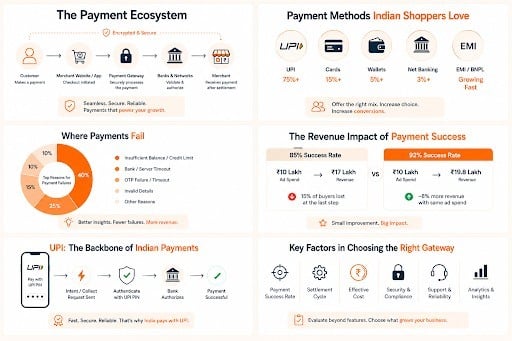
Most D2C brands spend months optimizing ads and product pages but overlook the final 30 seconds of the customer journey - the payment page. That is where a significant share of sales is actually lost.
The pattern is consistent across Indian ecommerce. A brand drives record traffic during a sale event, the funnel performs as planned, and yet 10-18% of shoppers who click "Pay" never complete the transaction.
The loss rarely has a clear owner: marketing attributes it to technology, technology attributes it to the gateway, and the gateway attributes it to the banks. Meanwhile, customers the brand has already paid to acquire exit at the last possible step.
A payment gateway is a conversion lever, a trust signal, and a cash-flow engine. And during festive sales, the most stress-tested component of the entire ecommerce stack.
This guide examines how a payment system for ecommerce actually works, what Indian customers expect at checkout, where revenue quietly leaks, and how to select India's best payment gateway for a specific business - because there is no universal answer, only a right fit.
What is a Payment Gateway?
A payment gateway is the layer that carries a payment instruction from the customer to the banking system and returns an approval or a decline.
The flow, at its simplest:
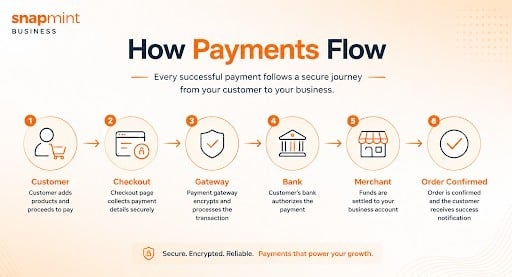
When a customer taps "Pay ₹2,499," three processes complete in seconds:
- Authentication
This means verifying the customer's identity through a UPI PIN, card OTP, or biometric. Under RBI's two-factor authentication rules, this step is mandatory for most domestic transactions.
- Authorization
Most payment failures occur here: insufficient balance, expired cards, or bank server timeouts.Basically the customer's bank verifies the balance or credit limit and approves or declines the charge.
- Settlement
Once approved, the payment reaches the merchant’s account within a set period. The payment gateway also encrypts customer payment details, keeping sensitive information secure.
Its role is simple: process, verify, secure and settle the payment.
Why Payment Gateways Matter More Than Most Founders Realize
Let us do the basic math here:
A brand spends ₹10 lakh a month on acquisition, converts at 2%, and operates at an 85% payment success rate. Fifteen percent of customers who decided to buy - who cleared the ads, the product page, and the cart - were lost at the final step, at full acquisition cost, with zero revenue.
Improving payment success from 85% to 92% adds roughly 8% to revenue with no additional ad spend. Few levers in ecommerce deliver returns of that shape.
Conversion, however, is only the first layer. The gateway influences:
Trust.
A checkout that redirects to an unfamiliar page, loads slowly, or looks visually disconnected from the brand triggers hesitation. This leads to abandoning or retreating to cash on delivery.
Failed payments
A failed payment is not a neutral event. The customer saw money debited (or feared it was), received an error, and is now anxious.
Some retry, many do not, a few contact support, adding cost on top of the lost sale. Gateways with intelligent retry logic and specific failure messaging recover a meaningful share of these transactions.
Gateways without it simply leak.
Checkout abandonment.
Industry research consistently places cart abandonment near 70%, with checkout friction among the leading causes. Every additional field, redirect, and OTP delay compounds the loss. Detailed approaches to fixing the funnel are covered in Snapmint's guides oncheckout optimization andreducing abandoned carts.
Repeat purchase behaviour.
Payment experience functions as retention infrastructure, even though it is rarely considered that way.
Key action:
Payment success rate belongs on the same weekly dashboard as ROAS and conversion rate. Metrics reviewed weekly get fixed; metrics buried in gateway dashboards do not. A measurement framework is detailed in Snapmint's guide on payment success rate.
How an Ecommerce Payment Gateway Actually Works
Tracing a single transaction end to end reveals exactly where revenue leaks occur.
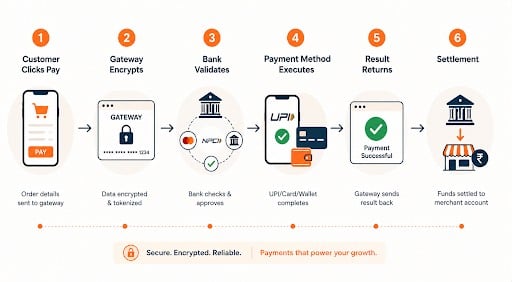
- Customer clicks Pay
- Gateway encrypts
- Bank validates
- UPI/Card/Wallet processes
- Success or Failure
- Settlement
Step 1 - The customer clicks Pay.
Order details (amount, order ID, merchant ID) are packaged and passed to the gateway. Slow checkouts - heavy scripts, poor mobile optimization - lose customers before the gateway is even involved.
Step 2 - The gateway encrypts.
Card numbers and bank credentials are encrypted and, under RBI's card-on-file rules, tokenized: the actual card number is replaced with a network token and never stored raw anywhere in the chain.
Step 3 - The bank validates.
The gateway routes the request to the acquiring bank, which communicates with the card network or NPCI (for UPI), which reaches the customer's issuing bank. The issuing bank verifies the account, the balance, and the transaction's risk profile.
Step 4 - The payment method executes.
UPI opens an intent flow or sends a collect request. Cards trigger an OTP. Wallets verify balance. Each method carries its own failure modes: UPI collect requests expire, OTPs are delayed by telecom congestion, wallet balances fall short.
Step 5 - The result returns.
A well-designed gateway returns the outcome quickly and specifically. "Payment failed" is useless to the customer. "Insufficient balance - try another method?" recovers sales. The gap between those two messages is measurable revenue.
Step 6 - Settlement.
Funds move from the customer's bank through the acquiring bank into the merchant account, minus fees, on the agreed cycle.
Types of Payment Methods Indian Customers Expect
Indian ecommerce has no single dominant payment method - it has a portfolio, and checkout coverage must reflect it.
|
Payment Method |
Popularity |
Best For |
|
UPI |
Very High |
Everyone - the default for most of India |
|
Credit Cards |
High |
Premium buyers, metro customers, high AOV |
|
Debit Cards |
High |
General population, salaried buyers |
|
Net Banking |
Medium |
Older users, high-value transactions |
|
Wallets |
Medium |
Fast checkout, small-ticket purchases |
|
EMI |
Growing |
High-AOV categories - electronics, furniture, jewellery |
|
BNPL / Pay Later |
Growing Fast |
Young buyers, first-time credit users |
|
COD |
Declining but important |
Trust-building with first-time and non-metro buyers |
Three realities the table does not show:
The credit card ceiling is structural.
Only a small fraction of Indian consumers - commonly estimated around 5% - have access to credit cards and card-based EMI. A payment flexibility strategy built on "credit card EMI is available" serves roughly one visitor in twenty.
COD is a symptom, not a preference.
Most COD orders are trust hedges: the customer was not confident enough to prepay. High COD share drives high RTO (return-to-origin), one of the most damaging cost lines in D2C - forward shipping, return shipping, repackaging, and frequently a product that can no longer be sold at full price. Every percentage point shifted from COD to prepaid flows directly into margin. The mechanics are covered in Snapmint's guide onreducing RTO in ecommerce.
Method mix varies by category and geography.
A metro electronics buyer and a tier-3 apparel buyer pay differently. Brands should pull their own method-mix data before making assumptions.
Key action:
Audit the live checkout against this table. Every missing method customers expect is an invisible drop-off - it never registers as a "payment failure" because the customer never attempts payment at all.
Why UPI Has Changed Indian Ecommerce
Any brand launched after 2020 has never known Indian ecommerce without UPI - and it is difficult to overstate how thoroughly UPI rewired customer behaviour.
UPI processes billions of transactions monthly and has become the default payment language of the country. For ecommerce specifically, several mechanics matter:
Intent flow versus collect flow.
In intent flow, the customer taps Pay on a mobile site, their UPI app opens with the amount pre-filled, they authorize with a PIN, and they return to the confirmation page - fast, low-friction, high success. In collect flow, the customer enters a UPI ID, receives a request in their app, and must locate and approve it before it expires - slower, with routine timeouts. A UPI gateway that defaults to collect flow on mobile leaves conversions unclaimed.
QR remains essential for desktop.
Scan-to-pay is deeply habitual. A desktop checkout displaying a UPI QR code converts shoppers who would never type a card number.
Success rates are winnable ground.
UPI success varies meaningfully across gateways based on routing quality, bank integrations, and retry handling. Strong implementations sustain success rates in the low-to-mid 90s; weak ones sit ten points lower. Ten points of payment success is not a rounding error - it is a growth lever.
Behaviourally, UPI lowered the prepayment barrier.
Customers who would never share card details pay by UPI without hesitation. This makes UPI the most effective weapon against COD dependence: a fast, native UPI experience converts trust-hedgers into prepaid buyers.
The newer development: UPI is becoming a credit rail, not only a debit rail. Cardless EMI on UPI means the 95% of consumers without credit cards can split payments using the instrument they already trust. For high-AOV brands, that is a structural change - examined in Section 9.
Key action: Complete a purchase on the brand's own store over UPI, on a mid-range phone, on a 4G connection. If checkout exceeds roughly 15 seconds or routes through a redirect, the country's most popular payment method is underperforming on that store.
Features Every D2C Brand Should Look For
The truth behind the search term: India's best payment gateway does not exist as a single answer.
On paper, most payment gateways offer the same features. What matters is how they affect your revenue, costs, and customer experience.
Must-haves features (deal-breakers if missing)
Payment success rate (by method, by bank).
The single most important number. Demand dashboard-level transparency, not claims.
Smart retry logic.
When a transaction fails, the gateway should automatically retry through an alternate route or prompt the customer with a working alternative.
Settlement speed and reliability
T+1 should be the baseline. Clarify cutoff times, settlement holidays, and long-weekend behaviour.
Full card stack with tokenization.
RBI-compliant tokenization across major networks, plus card EMI for the minority who hold cards.
Platform integration
Actively maintained native plugins for Shopify and WooCommerce, with one-page checkout support. Shopify-specific rankings are covered in Snapmint's guide to thebest Shopify payment gateways.
Should-haves (revenue levers as you scale)
Pay in 3 and Pay Later integrations (cardless EMI & BNPL)Cardless EMI and BNPL integration.
For any brand with AOV above roughly ₹3,000, flexible payment options are conversion infrastructure, not an accessory. Native integrations convert better than bolted-on redirects - verify which providers the gateway supports natively.
Analytics
Failure reasons, bank-wise trends, method mix, cohort behaviour. What cannot be seen cannot be fixed.
Refund automation
Slow refunds generate support tickets and erode trust. One-click and API-triggered refunds with clear customer communication are the standard to expect.
Fraud detection
Velocity checks, risk scoring, and increasingly, RTO risk prediction on COD orders.
Checkout SDK quality
A fast, polished, mobile-first SDK - evaluated on a mid-range Android device, where most Indian customers actually shop.
Nice-to-haves features
International payments.
Only where needed. Global acceptance typically costs 3-4% plus currency conversion; paying for unused reach is waste.
Deep UPI support.
Intent flow on mobile, QR on desktop, high success rates, and UPI AutoPay for any subscription ambitions.
Common Payment Problems That Reduce Revenue
The recurring revenue leaks in Indian D2C payment stacks, roughly ordered by cost:
Failed payments nobody investigates.
The brand knows its overall success rate but not the underlying causes.
OTP failures.
Delayed SMS during network congestion, customers switching apps to read the OTP and losing the session, aggressive timeout settings.
Gateway downtime at peak.
Brands running large event sales should treat peak capacity as a formal evaluation criterion.
Slow checkout.
Every additional second of payment-page load time taxes conversion, and heavy checkout scripts on mid-range phones are a silent, persistent drain.
Excess steps.
Every field not strictly required is conversion not collected.
Low-trust checkout design.
Missing security markers, branding inconsistency between store and payment page, or totals that change at the final step.
Late-surfacing fees.
Convenience fees or shipping charges appearing on the payment page are among the fastest documented ways to lose a customer who was ready to pay.
Poor mobile UX.
Small tap targets, keyboards covering input fields, OTP fields without auto-read. Testing on a ₹12,000 Android device reveals what testing on a flagship phone conceals.
Payment Gateway Pricing Explained
Gateway pricing appears simple on the website and becomes complicated in the contract.
Here are the details of payment gateway pricing:
Setup fees.
Increasingly rare and almost always negotiable; many gateways waive them on request.
Transaction fees / MDR.
The Merchant Discount Rate - the percentage charged per successful transaction, varying by method. Typical Indian ranges: UPI at the low end (regulatory pressure keeps it minimal, often near zero for smaller merchants), debit cards low, credit cards higher, international and premium cards highest, with EMI and BNPL carrying their own structures. Blended, most D2C brands land between 1.5% and 3.5%.
Refund charges.
Some gateways return the MDR on refunds; some retain it; some charge additionally. For a brand with a 15% return rate, this clause is material. It should be read before signing, not after.
Chargeback fees.
Card disputes typically carry a flat fee (commonly a few hundred rupees) regardless of outcome, plus the operational cost of contesting.
Settlement-related costs.
Standard settlement should be free. Same-day or instant settlement often carries a premium - occasionally worth paying during festive periods for cash-flow reasons, wasteful year-round.
GST.
18% applies to the gateway's fees (not the transaction value). It surprises teams at reconciliation when unbudgeted.
Hidden line items.
Minimum monthly commitments, platform or maintenance fees, charges for advanced analytics tiers, fees for payment links or additional users. Individually minor; together they can add 15-20% to effective cost. The complete fee schedule belongs in writing before signature.
The governing principle: compare gateways on effective cost per successful order, never on MDR alone. A gateway charging 2.0% with a 92% success rate generates more net revenue than one charging 1.7% with an 86% success rate - in every scenario. That arithmetic, run on the brand's own volumes, should anchor every negotiation.
Key action: Beyond ₹50 lakh-₹1 crore in monthly volume, everything is negotiable - MDR, settlement speed, support tier. Gateways compete hard for scaled D2C brands. Pricing unrevised for a year is pricing being overpaid.
Security & Compliance
Security is frequently treated as the gateway's problem. It largely is - but five items require merchant-side verification, because when security fails, it is the brand's name in the customer's SMS.
PCI DSS compliance. The global standard for card data handling. The gateway must hold PCI DSS Level 1 certification. The practical benefit: with a compliant gateway handling card data end to end, the merchant's own compliance burden shrinks dramatically because raw card numbers never touch the merchant's servers.
Tokenization. RBI mandates that merchants and aggregators not store actual card numbers; cards are replaced with network tokens. Beyond compliance, tokenization is what makes saved cards safe - a stolen token is useless elsewhere. Confirm coverage across all major networks.
RBI guidelines and Payment Aggregator licensing. India's payment aggregation ecosystem operates under formal RBI authorization, with capital requirements, audits, and escrow rules that protect merchant settlement funds. Brands should work only with gateways holding (or demonstrably in process for) PA authorization - this is protection, not paperwork.
Two-factor authentication. RBI's 2FA requirement (OTP, PIN, biometric) applies to most domestic transactions. It adds friction, and it is also a key reason Indian card fraud rates compare favourably with many markets. The differentiator is implementation quality: auto-read OTPs, sensible timeouts, smooth recovery from failure.
Encryption and fraud monitoring. End-to-end encryption in transit is table stakes. The differentiator is active fraud tooling: velocity checks, device fingerprinting, risk scoring, and increasingly, AI-driven RTO risk prediction that flags suspicious COD orders before dispatch - converting fraud tooling from a cost centre into a margin protector.
Key action: Security arguments with customers are never won after an incident. Verify certifications before signing, retain compliance documentation on file, and display recognizable trust markers at checkout. Prevention is cheap; reputation repair is not.
Shopify & WooCommerce Payment Gateway Integration - What to Ask Your Tech Team Before Go-Live
Integrating a payment gateway with Shopify or WooCommerce is much easier today. But a smooth setup still depends on getting the small details right.
For both platforms: Use the payment gateway's official plugin instead of a third-party plugin. Before installing, check that it is officially maintained and has been updated recently.
Avoid installing multiple payment apps. Having several payment integrations can create conflicts. One properly configured payment gateway works better than multiple overlapping apps.
Testing and Sandbox
Every reliable payment gateway offers a sandbox (test environment). Use it to test all key payment scenarios, including:
- Successful payments
- Failed payments
- Timeouts
- Full refunds
- Partial refunds
Before going live, also perform real low-value transactions (₹1–₹10) to ensure everything works correctly. Test every payment method you plan to offer, including:
- UPI (Intent and Collect)
- Major card networks (Visa, Mastercard, RuPay, etc.)
- Net banking (at least two different banks)
- Wallets
- EMI and Buy Now, Pay Later (BNPL) options
Skipping sandbox testing doesn't actually save time. It only moves the problem to after launch, when real customers and real money are involved. A payment that gets debited but the order doesn't confirm. A refund that never reaches the customer. A paid order that never shows up in your system. Each of these costs you a sale, creates a support ticket, and damages trust that took months to build.
Integration go-live checklist:
- [ ] All payment methods tested with real transactions, on mobile and desktop
- [ ] Webhooks verified - orders update correctly on success, failure, and refund
- [ ] Failure messaging is specific and offers an alternative method
- [ ] Confirmation emails/SMS fire correctly
- [ ] Refund flow tested end-to-end, including customer communication
- [ ] Checkout tested on a mid-range Android device over mobile data
- [ ] Settlement reconciliation verified daily for the first three days after launch
Mistakes Indian D2C Founders Make
The recurring patterns, in order of expense:
- Allowing COD to dominate. COD feels customer-friendly; at scale it is an RTO machine that consumes margin. The fix is not eliminating COD but making prepaid so easy and attractive - native UPI, EMI options, modest prepaid incentives - that COD share falls naturally.
- Ignoring payment failures. The failure rate sits in a dashboard nobody opens, while representing the cheapest 3-8% of revenue growth available to the brand.
- Choosing the cheapest gateway. Effective cost per successful order is the only number that matters. Low MDR with poor success rates is expensive.
- Omitting EMI on a high-AOV catalogue. Selling ₹8,000+ products with no instalment option gives the 95% of customers without credit cards a binary choice: pay the full amount upfront, or leave. Most leave. The revenue cost of that gap is calculable - and most brands never calculate it.
- Under-optimizing UPI. Having UPI is not the same as having good UPI. Collect-flow defaults, missing intent flow, and absent desktop QR amount to the country's most popular payment method implemented at half strength.
- Not tracking payment success weekly. Metrics absent from the leadership dashboard do not improve.
- Neglecting mobile checkout. Teams test on flagship phones over office Wi-Fi; customers buy on mid-range Androids over 4G. Testing should happen where customers live.
- Running a single gateway at scale. Above ₹1 crore/month, single-gateway dependence is one outage away from a damaging festive weekend.
Key action: Score the brand honestly against these eight items, 0-10 each. Any score below 6 defines the payment roadmap for the next quarter. Most brands score below 5 on at least three - and fixing those three typically outperforms the next major marketing initiative.
.png)
FAQs: